p.372 #1
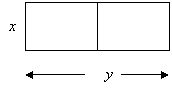
Maximize area:

Constraint:




Increases for 
Decreases for 
 maximum at

Total width: 150 ft
Length: 100 ft
p.372 #2
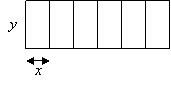
Minimize wall length:

Constraint:




Decreases for 
Increases for 
minimum at 

a) Rooms should be 14.289 ft by 24.495 ft
b) 10 rooms: 


p.373 #3
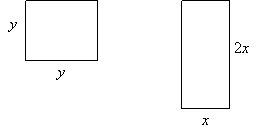
Maximize area:

Constraints:

a) smallest when  so
so 
largest when using all fence except minimum used by square
(40 ft) so 


b)


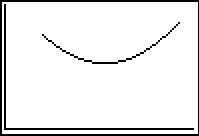
[0, 100] x [0, 20000]
c)


Decreases for 
Increases for 
minimum at 
Looking for maximum, so consider endpoints:

maximum area is 17,522.222 sq. ft.
p.372 #4

Constraints:

Maximum circle size






Decreases for 
Increases for 
minimum at 
b) maximum must occur at endpoint


maximum area when  (all fence used on
circle)
(all fence used on
circle)
p.372 #5
Maximize volume:

Constraint:




Increases for 
Decreases for 
maximum at 

a) 6.325 cm by 6.325 cm by 3.162 cm
b) conjecture: Depth is half of width
p.372 #7
Minimize cost:

Constraint:




Decreases for 
Increases for 
minimum at 

p.372 #10
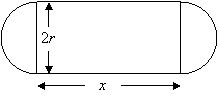
Minimize area:

Constraints:

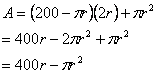


Increasing for 
Decreasing for 
maximum at 
Minimum must occur at endpoint
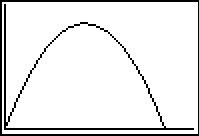
[0, 150] x [0, 15000]
Smallest r is 20.
Largest r occurs when
least straight lengths are used (i.e. ).



minimum occurs at 

p.372 #11

Minimize length of ladder, l:

Relate x and y using similar triangles:

Re-write l in one variable:

Find minimum using derivative:
(minimum  is equivalent to
minimum l)
is equivalent to
minimum l)

*YUCK! TIME TO USE MY CALCULATOR!*
Graph :
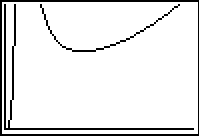
[0, 12] x [0, 200]
Minimum occurs at (5, 125)
Since minimum is 125, minimum l is approximately 11.180 feet.
p.372 #13
 Maximize
volume of cylinder:
Maximize
volume of cylinder:

Relate r and h using given perimeter:

Re-write V in one variable:

Find maximum using derivative:


Max occurs when  , so
, so 
400 mm radius and 200 mm height
p.372 #15
 a)
a)

b)

Relate r and h:

Rewrite A in terms of r:

c) Find minimum using derivative:



4.133 cm radius, 8.266 cm height
Can is short and fat
Ratio of diameter to altitude is 1 to 1
d) 

The normal can uses close to the same amount of metal

Normal can uses about 1.5% more metal
e) 
about $6.4 million
p.372 #17
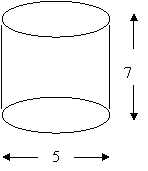 a)
a)


Relate r and h together:

Re-write A in terms of one variable:

Minimize A:



Dimensions: radius 3.524 cm, height 3.524 cm
b) Ratio of diameter to altitude is 2 to 1
c)


Savings per year: $754,299.93
d) left to you J
p.372 #19


Find maximum by graphing A:
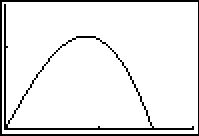
[0, 2] x [0, 1.5]
Maximum at (0.860, 1.122)
 ,
, 